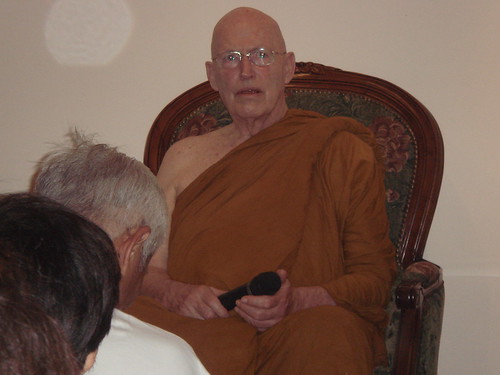
Thai Buddhists and Muslims living in peace
Islam is a monotheistic faith that began in Arabia in the seventh century and quickly spread across North Africa and the Middle East. Today, it is found across Asia and has sizeable populations in both North America and Europe. It is centered on the teachings in its holy book he Koran (or Quran) which is believed to contain the actual words of Allah (God), as revealed to the religion’s founder, the Prophet Muhammad. As it is so important to Islam, it would be a good place to start in a comparison of the Buddha and Islam. Resembling some fundamentalist Christians’ view of the Bible, most Muslims consider the Koran to be the perfect word of God, and therefore everything in it is true and to be followed to the letter. This dependence upon the word as an infallible source of inspiration is something that stands in contrast to the insight of the Buddha, which reveals the truth of this moment as it is, prior to language. Scripture, and other Buddhist teachings, exist to assist on our awakening, not to demand our unflinching belief.
In the Koran, it is made clear that God is one, that is to say He is beyond association with any image or form, including Jesus. (Jesus is considered a prophet in the Koran, but neither the Son of God nor God Himself.) Therefore, Islam is a monotheistic religion that teaches the only unforgivable sin that we can commit is to identify anything with Allah, which means Christians that belief Christ to be God are in deep trouble! From the Buddha’s perspective, this belief in a single divine being that is all-powerful creator of the universe is simply a form of wrong view that takes us away from the truth of this moment and into the realms of fantasy. Traditionally, moreover, gods are recognized in Buddhism but are neither eternal nor omnipotent, so the Koran’s description of God is in direct contradiction to the understanding of the way things are according to the Buddha.
In the name of Allah, the Merciful, the Compassionate. All praise belongs to Allah, the Lord of the Worlds, the All-Merciful, the All-Compassionate, the Master of the Day of Judgment. It is You we serve and to You we pray for support. Guide us on the right path, the path of those that You have blessed, not that of those with whom You are angry, nor of those who go astray.”
(Koran, Sura 1.1-7)
(Koran, Sura 1.1-7)
Allah is not only creator but destroyer, not only the Compassionate bit also the Judge, and therefore there is as much fear of God as there is love for Him within Islam. Muslims believe that it is through God’s help that they can overcome life’s obstacles, and that if He chooses so, all their efforts will be in vain. It is up to every Muslim to follow the path of Islam, paying daily homage to Allah and living a righteous life, the reward for which will be eternity in paradise after one dies. This Muslim path is similar in some ways to the Buddhist Path, in that it includes a strong moral foundation to it, encouraging honesty and respectful behavior to others amongst other qualities. The emphasis on belief in Allah within Islam makes it very different to the Buddhist ideal of enlightenment, in which belief is irrelevant with the arising of the wisdom of the Buddha.
Part of the Muslim path to salvation is to perform the rituals of Islam and study the Koran. Like Buddhism, the Koran teaches that we are each responsible for our actions and thoughts, and that it is up to us to worship Allah or not. In this, there is a parallel in the Buddha’s teaching that we are all responsible for our own karma. The big difference is that like other theistic religions, Islam states that it is the Person of God that judges our actions as good or evil, whereas the Buddha taught that karma and its results are a natural process independent of any god or gods.
The ummah, or Islamic community is a crucial element in Islam, and in this it has similarities to the Sangha in Buddhism. Muslims are renowned for looking out for each other, and this communal spirit has its roots in the Koran, which teaches that the purpose of the Muslim community is to create a just and holy society. In the Koran, there are rules pertaining to marriage, inheritance and various other aspects of law which form the basis for Islamic law (sharia). The Buddha also taught that Buddhists should behave with wisdom and compassion towards each other. Here, there are parallels with Islam’s attitude to Muslim society, but an important difference is that Buddhists are encouraged to treat all beings with kindness, not just other Buddhists or even only humans.
After the Koran, the next most important source of Islamic teachings come from the Prophet Muhammad, who’s life and teachings (hadith) are also used by Muslims to guide them through life. He is seen as the perfect human, a devout God-fearing man who lived with complete devotion to the will of Allah. He was brave and led his followers in battle against their enemies, spreading Islam across Arabia, both in battle and in peace. Although discouraged from worshipping Muhammad, he is nevertheless as a role model for all Muslims, just as the Buddha is seen as a role model for all Buddhists.
“The most excellent jihad is that for the conquest of self.”
This has strong parallels with the following verse from the Buddhist Dhammapada:
“Though one may conquer a million men in battle,
Yet he is noblest victor who conquers himself.”
In Islam, it is the utter surrender of self to Allah that is the ideal that every Muslim should aim for, and it is the act of worship that he or she will achieve such abandonment. But worship is seen as merely rituals in a mosque, for it is in everyday acts that Muslims can also submit to Allah’s will, by obeying Islamic law and being generous to their fellow believers. There are similarities here with the Buddha’s teachings, in that Buddhists are encouraged to be selfless, putting the interests of others before themselves. Surrender for the Buddhist, however, is neither to God nor the Buddha, but to the way things are (the Dharma), which centre on the realization that there is in truth no substantial separate self in the first place. There is a movement within Islam called Sufism which has produced exclamations that seem to go beyond the usual Islamic ideas of surrender, however:
“O Lord,
If I worship You
From fear of Hell,
Then burn me in Hell.
O Lord,
If I worship you
From hope of Paradise,
Bar me from its gates.
But if I worship You for Yourself alone
Then grace me forever the splendour of Your Face.”
(Rabiah, 8th Century Sufi)
This Face of Allah may be seen as the very Original Face of Buddha, as described in Zen Buddhism, and then we are in the realm beyond words and concepts (and beliefs) where the Buddha and Islam may truly meet, if not merge. This ‘Face’ could well be described as No-Face, or the space in which all things appear. It is not your face nor my face, but the Face of all, and certainly not the particular features of any Tom, Dick or Harriet. Another equivalence in the above verse by the Sufi mystic Rabiah is that the idea that we do something not out of hope for reward, but that we do it for its own value, whether that be worshipping Allah or chanting praise of the Buddha.
What we see when we compare the Buddha with Islam are many differences but also many similarities. If we focus solely on those things that are unalike, then they may seem to be worlds apart and grounds for dialogue and coexistence may appear fragile to say the least. But, if we also bring to light the aspects of Islam that compliment the Buddha and his teachings, then we have reason to believe that Muslims and Buddhists can live harmoniously together in this world, as they have done in the past across Asia. Of course, there have been times of strife, as when Islam first conquered India, or recently in Southern Thailand where an atmosphere of mistrust has descended into brutal conflict. But, if we focus on the teachings of Muhammad and Sufi mystics such as Rabiah, then we nay find the way to allow the Buddha and Islam to coexist in peace, something that both have been famous for promoting.