Friday, July 25, 2008

Listening to the Void #2


One of the hallmarks of human culture is its use of music to express just about every emotion and reflect the many variegated expressions of human activity such as religion, sexuality, nationalism or just having good old fun. At present, Chinese Buddhist music is emanating from the notebook on which this article is being written, and in response, feelings such as pleasure, devotion and peacefulness are inspired in my heart. Music is a powerful thing.

I recall that during the first Gulf War when Baghdad was being bombed some Iraqis would dance and sing in front of news cameras chanting the name of their country and (then) leader Saddam Hussein. They were using music to show defiance towards their attackers and support of the Iraqi regime. (Of course, many, many more Iraqis did not dance and sing on the streets like this, so whether these individuals reflected the sentiments of their fellow compatriots or not is an entirely different matter.) National anthems are a similar form of music, evoking a multitude of images and feelings in relation to one’s country in the hearts of those that recite them. Similarly, music is also an expression of cultural identity, and here in Thailand there are several traditional musical forms reflecting the different regions and strata of Thai society, all performed in schools, universities, and via the media as an affirmation of ‘Thai-ness’.

Most of us who have grown up in the West are familiar with the singing of Christian hymns. Sung with much fervor and devotion they are an integral part of most church services, encouraging loving feelings towards God and are also an expression of Christian identity. Monastics in the West have used plainsong or Gregorian chants to cultivate similar feelings accompanied by a reflective attitude to the songs. Go to any professional football match in England on a Saturday afternoon and you’ll see thousands of people chanting the praises of their favorite player and his teammates. This isn’t restricted just to football, of course; most sports have music and chants associated with them. Rugby, for instance, is notorious for its tongue-in-cheek and rather saucy chants heard during matches. Singing can therefore be a kind of affirmation of who we believe ourselves to be, whether we are singing for our country or our religion or even our sports team.

Of course, we listen to music for another good reason too: it’s enjoyable. Millions and millions of dollars are spent across the globe every year on the best-selling albums, and radios blast out the latest songs of the newest talent to hit the airwaves, along with older classics from the last century and beyond. Music is found in barn dances, weddings, discothèques, raves, birthday parties, stage shows, and of course, on the television. Mp3 players, i-pods, and even most video games contain music. My wife just purchased a new mobile phone that not only allows her to listen to mp3s but also lets her listen to the radio. Apparently, she can even make and receive telephone calls on the thing!

Listening to traditional Chinese Buddhist chants can reveal an important aspect of music that is usually overlooked: the space in between the notes. For, if all the sounds were drones going on and on simultaneously, it would be very difficult to discern any melody or rhythm in music. (And – unless distorted by modern technology – the human voice cannot drone on for much more than a few minutes, anyhow.) Even in music that uses drone-style sounds such as Indian music, only one instrument is normally used to make a droning noise which is used as a kind of background hum to the tunes played over it. And those tunes all have gaps in between the notes.

Let’s look closer at those gaps in music, for they point at an important aspect not only of sound but of life itself. Choosing a piece of music that isn’t too boisterous or chockablock full of many, many different sounds, devote this time to sitting down with an attentive mind and listening carefully. This can be done in a formal meditation position or sat or led down quite casually, as long as one doesn’t move around too much or become dozy and fall asleep. (Although, if you’re tired, why not go to sleep and do this experiment when less drowsy?)

Keeping pretty still and with eyes closed to cut out any visual interference with this experiment in sound, pay close attention to the chosen piece of music. Take in the various instruments on the song, focusing on each one in turn, noticing the particularities of the way they sound. For instance, one can listen to a bass guitar, recognizing its typically low muffled sound, creating a beat alongside any percussion being played. Also listen to the space in between the tune the bass is playing and see that the space is every bit as present as the bass guitar itself, but that normally we don’t place our attention on it so it goes unnoticed. Can you hear how the space not only lies in the gaps in between the notes of the music, but that it also surrounds them, never really going away – where can space go?! Indeed, prior to the first sound of the song there is space, and after the last note of the music has died away, space is present also. Space is here before the arising of sound, during the sound’s existence and after it has finished. Now, if you listen to the sounds that are arising where you are, there is also this peaceful silent space.

Unlike music, space doesn’t give us anything to grasp hold of and identify with. We can’t use space to express our nationalism, nor can it be used to illustrate our love of Jesus Christ, Amitabha Buddha or Sri Krishna. Space doesn’t inspire particular emotions such as love, hate, desire, loneliness, nor does it encourage the attachment that accompanies such feelings. Space is an openness which is experienced as the peace at the heart of the most discordant noise, and a void into which all sound falls eventually. If we focus on space, rather than the sounds that occur within it, we experience a widening of the otherwise limited human perspective. It’s difficult to react with any strong emotions to spaciousness; it is a void into which everything that we cling to as me and mine falls into.

Yet this isn’t as awful as it might sound, for if we let go of our attachments to sounds, sights, thoughts, memories etc, we experience them as they truly are, giving them the chance to express themselves in the fullness of being without interference from our ego. Then, we might well find that genres of music that previously were not appreciated can be heard in a more expansive way, without the negative presumptions of the ego to interfere. In the same vein, focusing on space can also help us to let go of negative feelings towards other human beings and creatures, making us less egotistical and reactionary. And even this ego itself can be seen in relationship to the void in which it appears, and we can know ourselves as we truly are perhaps for the first time, courtesy of the spaciousness that lies at our center.

Thursday, July 17, 2008

Dharma Day (Asalha Puja)

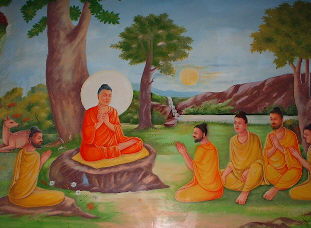
The Buddha delivers his first sermon

On the full moon of July Buddhists across the world celebrate Asalha Puja, or Dharma Day, commemorating the occasion of the Lord Buddha’s first Dharma discourse called the Dhammacakkappavattana Sutta, or ‘The Setting in Motion of the Wheel of Dharma Discourse’. This discourse followed the Buddha’s Enlightenment, and was given to five ascetics that were former disciples of the Blessed One. Upon hearing this teaching, one of the five ascetics called Kondanna had his spiritual eye opened, and became the first disciple of the Buddha to enter the Noble Path of Awakening. In recognition of this realization, his name was changed to Annata-Kondanna: ‘Kondanna-That-Knows (the Dharma)’.

So, what exactly was the Dharma taught by the Buddha on this full moon day in ancient India that led the ascetic Kondanna to see life in a radically different manner to before? As it exists today, the sermon is a brief but systematic description of the very heart of the Buddhadharma. To begin with, the Buddha talked of the Middle Way between the two extremes of self-asceticism and self-indulgence, describing it as the Noble Eightfold Path:

“And what is this Middle Way?
It is the Noble Eightfold Path, that is to say:
Right View, Right Intention, Right Speech, Right Action, Right Livelihood, Right Effort, Right Mindfulness, and Right Concentration. This is the Middle Way discovered by the Tathagata, which gives vision, gives knowledge, and leads to peace, to direct knowledge, to enlightenment, to Nirvana.” (Samyutta Nikaya 56:11, Pali Tripitaka)

The Buddha’s description of the Path begins with Right View for a good reason, for it is with Right View that the Buddhist Way can be first tread upon, used as a guide to one’s practice. Put simply, Right View is seeing the world from the viewpoint realized by the Awakened One himself – the Buddha – and living one’s life from this new vision. Right View is summed up in the famous teaching of the Four Noble Truths, which are as follows:

  1. Life is suffering
  2. Suffering is caused by desire
  3. Ending desire ends suffering
  4. The Path leading to the ending of suffering

The Path that leads to the ending of suffering is in fact the Noble Eightfold Path itself, so the Four Noble Truths contain the Path and vise versa, which a neat interdependence of the two aspects of Right View. Many people think that the Truths are negative with their focus on suffering, but Buddhists would respond that in the spirit of mindfulness – one of the eight aspects of the Path – recognizing the universal nature of suffering is simply seeing things as they really are, rather than through the rose-tinted glasses of naïve optimism. In any case, taken as a whole, the Four Noble Truths lead to the ending of suffering, so in fact they are a positive in that they point out the Way to the true happiness of Enlightenment.

Of course, the Buddhadharma is a highly-evolved set of teachings that include much, much more than the Middle Way and the Four Noble Truths, and in this light a broader perspective than the Buddha’s first sermon will reveal much. To start with, the Buddha followed the Dhammacakkappavattana Sutta with the Anattalakkhana Sutta (‘the Characteristics of Not Self Discourse’). It is this teaching that led Annata-Kondanna and his four companions to become fully-fledged enlightened beings, after which they became the first five monks in the Buddhist tradition. The Anattalakkhana Sutta centers on the realization that all of the five aggregates that we usually take to be our self are in fact empty of any such self. The five aggregates are:

  1. Form: the body
  2. Feeling: good, bad, & indifferent feelings
  3. Perception: memory & recognition
  4. Formations: thoughts & other mental objects
  5. Consciousness: that which is aware of the above

Here, the Buddha taught that all five aggregates are not self in that they cannot be made to be the way we might like them to be; they belong to nature, not us. Also, the Blessed One revealed that they are not self because they lead to suffering, and are impermanent. He taught that every one of the aggregates, whether internal or external, coarse or fine, inferior or superior, far or near, should be understood with Right View as “This is not mine, this is not what I am, this is not my self.” (Samyutta Nikaya 22:59, Pali Tripitaka)

Letting go of the delusion of selfhood is what the Middle Way exists for. Through developing the eight aspects of the Path we can transcend the delusion that each one of us is a self consisting of the five aggregates and identifying with one or more of those aggregates as being our core self. The body, for example, despite our earnest wishes gets sick and old; eventually falling apart either gradually prior to death or somewhat more swiftly following the grim reaper’s call. This holds true for the mind too, as feelings constantly change according to the stimuli present and our preferences. Feelings are fleeting things, never staying around for long morphing into something else usually without our consent or knowledge. Perceptions, formations, and even consciousness itself can all be seen to come and go of their own accord and rarely at our behest. They are expressions of nature, and as such do not make up a permanent, separate individual self.

Getting to the heart of the matter, as one might expect from its title, the Heart Sutra describes much the same teaching as contained in the Anattalakkhana Sutta, with an emphasis on the fact that all phenomena are empty of substance or self. An extremely popular and influential yet brief teaching from the Chinese Tripitaka and the Tibetan one, it has inspired countless East Asian Buddhists to reflect on the true nature of things as no thing at all. It does so in a style very different to the more systematic and logical language of the Pali Tripitaka:

“Form does not differ from emptiness, and emptiness does not differ from form. Form is emptiness and emptiness is form; the same is true for feelings, perceptions, formations and consciousness.”

All things are without self: they are empty. In this way, they are emptiness, and emptiness is also all things or selves. This understanding of emptiness is applied to all five aggregates of being, revealing the self-idea as a folly based on identifying with one or more of the aggregates as comprising a self, rather than recognizing that in fact they are empty of any such thing. Such threads of teaching run throughout the Buddhist scriptures, transcending differences of time, culture and place. Whether it is the Buddha’s first sermon or whether it’s a much later Sutra, the core of the teachings are derived from the Dharma itself, reflecting its brilliant light across the world. Here’s an extract from one of those later Sutras, which continues the themes found in the above examples:

Then Mahamati to the Blessed One, “Why is it that the ignorant are given to discrimination and the wise are not?”

The Blessed one replied, “It is because the ignorant cling to names, signs and ideas; as their minds move along these channels they feed on multiplicities of objects and fall into the notion of ego-soul and what belongs to it; they make discriminations of good and bad among appearances and cling to the agreeable. As they cling thus, there is reversion to ignorance and karma born of greed, hatred and delusion is accumulated. As the accumulation of karma goes on they become imprisoned in a cocoon of discrimination and are thenceforth unable to free themselves from the round of birth and death.”
(Chapter One, the Lankavatara Sutra, the Chinese Tripitaka)

Again, in this teaching there is much to found in common with the basic teachings found in the Dhammacakkappavattana Sutta. When referring to “names, signs and ideas” leading to “the notion of ego-soul”, this Sutra echoes the Buddha’s teachings on the five aggregates, once more drawing our attention to the fact that our apparent selves are in reality composite of various parts, and when this self-centered view is let go of, the light of Nirvana shines through the illusion of self. Wisdom is here represented as the non-discrimination between this and that, between you and me, between self and not-self; without clinging and the desire that causes it, there is no ego-soul left to suffer.

The Dharma is an amazing gift that the Buddha and his successors have left to the world. It illumines the darkest aspects of our lives with the wisdom that can help us to free ourselves of the attachment to the idea of self that blights human existence. Dharma Day is great opportunity to reflect on this wondrous gift and how best we can respond to it, not just today but over the coming years of our lives. For, without the Buddhadharma where would we be? We’d be caught in the trap of delusion, being born life to life without any idea how to escape this suffering existence. Homage to the Dharma!

Thursday, July 10, 2008

Master Xu Yun & Layman Pang

Zen Master Xu Yun
“When I chop wood, I chop wood;
and when I carry water, I carry water.”
(Layman Pang, died 808 C.E.)


Master Xu Yun, who is said to have lived for one hundred and twenty years, passing away in 1959, was a great Zen monk. He mastered Zen – or Chan as it’s known in China – over many, many years, having superb disciples such as Master Xuan Hua. As with Master Hua, Master Xu Yun was renowned as a wonderful orator, explaining the Way of the Buddha in all its profundity with a wit and the common touch. An example of his ability to share the Buddhadharma with such humor and universal appeal was his teachings on Layman Pang. And, as the following quote shows, he wasn’t averse to learning from the example of a layman if that layman was steeped in the Dharma – and layman Pang sure was steeped!

“Sometimes ordinary folks get the idea that the meaning of Chan is so profound that only men and women who’ve been ordained in the Dharma can possibly fathom it. But that’s just not so. Actually, we priests often feel that we’re in way over our heads. And every now and then, while we splash about, trying to look good treading water in our nice uniforms, along comes a civilian who zips by us, swimming like an Olympic champion. Such a civilian was Layman Pang. He would have won Chan’s gold medal. He’s been a hero not only to centuries worth of other laymen, but also, I confess, to every priest who’s ever studied his winning style.”
(Master Xu Yun, ‘Empty Cloud’)


So, what was Layman Pang’s “winning style”? Pang Yun (to give him his full name) was a master of ‘natural Zen’, applying the Way to every day life, whether in a monastery staying with monks, or living the life of a layman, with a wife and daughter. Indeed, his family was crucial to his own understanding of Zen, as the following incident shows. One day, Pang Yun expressed his frustration at trying to master Buddhist teachings, moaning how difficult it was to his wife. She retorted that in fact it was easy, for whilst her husband had been studying words, she had been studying the grass and the Buddha Nature that’s reflected in every dewdrop. Ling Zhao, their daughter, was passing by and remarked that they were just two old people foolishly chattering, to which her father asked what her experience was. She said:

“It’s not difficult, and it’s not easy. When I’m hungry, I eat. When I'm tired, I sleep.”

This response, along with the quotation from Layman Pang himself at the top of this article, are two of the most pondered over statements in the history of Zen Buddhism, and yet they are from two members of the same family, neither of whom was a monastic! Master Yun’s readiness to learn from such worldly (and yet non-worldly) people is a sign of his own wisdom. And this wisdom was not solely expressed in the somewhat paradoxical language of Zen, for Master Yun could also explain the Dharma – the way things are – in more traditional Buddhist style:

“Fundamentally, our four elements are void and the five aggregates (skandhas) are non-existent. It is only because of (our) wrong thoughts which grasp (everything) that we like the illusion of the (impermanent) world and are thereby held in bondage. Consequently, we are unable to (perceive) the voidness of the four elements and (to realize) the non-existence of birth and death. However, if in a single thought, we can have an experience of that which is not born, there will be no need for those Dharma doors expounded by Shakyamuni Buddha.” (Master Xu Yun, ‘Discourses and Dharma Words’, p.53)

This experience of the unborn, a synonym for enlightenment in Buddhism, is what drove Layman Pang from his home to tour the Zen monasteries of China, seeking out the guidance of the masters that resided in them. He met many of the famous teachers of his time; famous in Zen circles to this day, such as Master Ma Zu, with whom he had some illuminating conversations. In fact, on their first meeting, the Master had a profound effect on the layman. Pang Yun asked where he could find a man who was unattached to material things, to which Master Ma Zu replied, “I’ll tell you when you’ve swallowed West River in one gulp.” Master Xu Yun sees this as the decisive moment in Layman Pang’s cultivation of the Way:

In grasping that one remark, Pang was able to complete his enlightenment. He saw that Uncritical Mind was not enough. His mind had to become as immense as Buddha Mind; it had to encompass all Samsara and Nirvana, to expand to Infinity’s Void. Such a mind could swallow the Pacific.”
(Master Xu Yun ‘Empty Cloud’)


One day, Layman Pang approached Master Ma Zu and stood over him, asking the monk to look up. Master Ma Zu looked down, however, to which the former said, “How beautifully you play the string less lute!” Master Yun interprets this to mean that by gazing downwards like the layman, Master Ma Zu was acknowledging that there was no difference between them, in that they were actually one and the same being. For some reason, Master Ma Zu then looked up, and as he brushed past Pang Yun, the latter remarked that the monk had bungled things, trying to be clever! Layman Pang stayed with Master Ma Zu for some time, until he realized he had no more to learn from him. It all sounds so immediate, so easy, doesn’t it? That we all had the abilities of Layman Pang! So why is it that we don’t latch on to the unborn more readily? Master Yun has made the following observation:

“It is only because of our insatiable desires since the time without beginning that we now drift about in the sea of mortality, within which there are 84,000 passions and all sorts of habits that we cannot wipe out. (In consequence), we are unable to attain the truth and to be like Buddhas and Bodhisattvas who are permanently enlightened and are free from delusion.”
(Master Xu Yun, ‘Discourses and Dharma Words’, p.67)


Pang Yun and his daughter Ling Zhao grew old together, traveling around China, becoming legends of Zen Buddhism. Their last abode was a cave in a mountain. Layman Pang new it was time for him to die, so he sat on the rock which he used for meditation and prepared to pass away as the midday sun would pass overhead. Ling Zhao, however came into the cave and told her father to go outside and look at the eclipse of the Sun that was occurring. He went out to look at this extraordinary event, but saw no such thing, just the passing of midday. Returning to the cave, he found his daughter dead, sitting upright on the rock, to which he said, Oh that girl! She was always ahead of me.” Layman Pang did pass away himself one week later. The last words of Layman Pang are contained in the following poem, which is a perfect summing up of both his and Master Xu Yun’s teachings to finish with:
“Vow to wipe out all that is;
Beware of making real what is not.
Life in this (mortal) world
Is a shadow, an echo.”
(ibid. p.73)

The two books referred to in this article are available for free download from the Internet at the following locations:

Empty Cloud: The Teachings of Master Xu Yun

Master Hsu Yun's Discourses and Dharma Words


More poetry by Layman Pang is featured on the excellent Buddhist blog 'Stuttering Buddha' here:

Verses by Layman Pang

Wednesday, July 2, 2008

Listening to the Void #1

Douglas Harding - "Hear who you really are!"

“All conditioned phenomena
Are like dreams, illusions, bubbles, shadows,
Like dew drops and a lightning flash:
Contemplate them thus.”
(The Buddha, in the Diamond Sutra)

Alongside the brilliant Buddhist monks such as Ajahn Chah and Master Hua, there is another teacher that will appear on these pages from time to time. Although not a monk, nor indeed a Buddhist as such, this man had something very important to share with all enquiring Buddhists, not to mention anyone else for that matter. His name was Douglas Edison Harding, an English philosopher, author, and workshop leader that spent the last three decades of his life dedicated to sharing what he called “seeing who we really are”. He will be referred to herein as DEH.

The workshops led by DEH were mainly geared towards seeing our innate unborn reality using experiments based on the visual sense. Hence, the emphasis given to seeing who we really are. But, as DEH admitted himself, any method that reveals a universal truth cannot be dependent on only one sense, for then it wouldn’t be a universal truth, merely a partial one. With this in mind, DEH did develop a few other experiments that related to other senses, including the mind. For now, however, we will focus on another of the physical senses; hearing. Here is an experiment in awareness developed by DEH:

Closing your eyes, listen intently to any sounds that are arising in this present moment. Notice the particular qualities of each sound: their pitch, length, volume, rhythm, etc. Dwell for a short time on each individual noise, taking the time to recognize its characteristics. Next, turn attention around to listen to the listener. Can any such qualities be associated with that which takes in all these various sounds? Or is it the case that whilst the things heard have a range of particulars that mark them out, the listener is without any such characteristics. Here, there is no pitch, no length, no volume, and no rhythm etc. Here, is a silence alive with the sounds that it hears, but which itself is devoid of any such marks. Those things arise in an alert no-thing that is spacious awareness.

Sitting at my desk now, I can hear the fan humming behind me, the subsequent wind blowing in my ears, the tick-tock of the clock, my wife ironing in the next room, and the tapping noise as I type on the keys on my notebook. All these sounds are arising in what can only be described as no sound at all. Rather, it is the very absence of sound that allows them to be heard, just as it is the absence of vision that allows sights to be seen, and the absence of thinking that allows thought to be known, etc. On presence evidence, as DEH so often pointed out during his long and productive life, all phenomena can be heard, seen, thought, etc. as occurring in the unknown knower.

This unknown knower is the one unchanging factor in our ever-changing identities. It is without form, whereas everything else that we experience as being either self or not self is delineated by its very form. It is timeless, whereas everything else that we experience is governed by time, growing older by the second until finally dying. That tick-tock of the cosmic clock finds no one here to call time on, if the evidence is examined carefully. And this relates fundamentally to the question put to us by DEH: what use is a life if it is lived without ever looking to see who’s actually living it?

The Buddha taught that all created things – and this includes bodies and minds – are impermanent, unsatisfactory, and not-self. That things are impermanent is self-evident, in that we can observe how they decay and eventually die away. Sounds can be observed in this light too, as they arise, exist, and then cease. Everything is unsatisfactory in that it cannot satisfy us forever. Eventually, anything will come to bore us, disgust us or simply cease to satisfy us. Even those things we presently enjoy will become abhorrent to us if we have too much of them for too long. Imagine listening to your favorite song for a thousand years – you’d be sick of it after a thousand minutes! As to being not-self, can we control our bodies not to age, not become sick and not to (at some point) die? And anyone who’s meditated will know how the mind thinks what it thinks despite the will’s best efforts to control it. Both body and mind do not truly belong to the self: they are on loan from nature, and will go their own natural way in time.

The Buddhadharma also points to the void, the emptiness that is at the heart of all phenomena. Beyond all the myriad things that go to make up a living being, there is that indefinable no-thing that is neither impermanent nor unsatisfactory; indeed it is the absence of self that reveals what some – including DEH & many Buddhists – have deemed our true Self. Here, we begin to fall into the nebulous region of defining that which is devoid of characteristics. A hopeless task if there ever was one. Self, no-self, void, God, Tao, Zen, emptiness, Brahman, Mind, Buddha Nature – the words will always fall short of the reality, for the reality is beyond the grasp of the mind and its concepts. Talking of words, here’s another experiment to test out true nature in this moment:

Close your eyes. Say a word, any word will do, but let’s take the word ‘Buddha’ as an example. Speaking out aloud, ‘Buddha’, notice the various qualities of the word and the voice pronouncing it. Repeat this several times, each time focusing on the nature of the word and your voice. Now say the word again, but this time listen to that which is aware of ‘Buddha’. Is that which listens made of two syllables like the word it is conscious of, or is it empty of such qualities? Repeating the word again, can the listener said to be of such and such duration or consisting of particular sounds like ‘Buddha’? Take some time over this, becoming aware of that which is spoken and that which is listening.

DEH was keen for those that did his experiments to find out the answers to this research for themselves, and I’m not about to tell you how it is for you. In truth, how could I, for I can only really know the truth as it’s presented here, where I am. You, on the other hand, can see the way things are right where you are; it is up to each and every one of us to ascertain whether the sounds that we make and those that are around us are part of a real, enduring self, or as quoted from the Diamond Sutra at the top of this article, are as “dreams, illusions, bubbles, shadows, like dew drops and a lightning flash”.

Returning to this moment, the sound of a Thai soap opera can now be heard: not the most edifying of sounds! And yet, if the silence that is ever-present in the present is attended to, even the cackles and screams of demented soap characters can be easily tolerated as ephemeral phenomena in the void. There’s a saying in modern parlance which goes, “It ain’t over until the fat lady sings”, and yet even she, as a being made of various aggregate parts, is bound to become forever silent. And if you listen to her warbling, you can also hear that very same silence which is located in the one place we would normally never think of looking: right here.

Thursday, June 26, 2008

A Buddhist Glossary


Although every attempt is made on Buddha Space to avoid unnecessary use of complicated or unfamiliar terminology, Buddhism has a long and sometimes complicated history, and the terms found in it have often evolved a meaning peculiar to it. To help the reader circumnavigate the murky waters of such semantics, the following glossary is offered. If any mistakes or glaring omissions have been made, please use the post’s comments feature to offer your assistance in improving these efforts. All non-English terms are Sanskrit except where stated, the latter being used for Mahayana terms. Pali is an Indian language closely related to Sanskrit used in Theravada Buddhism. The words in bold are the usual ones to be found on Buddha Space.
Ajahn (Thai): ‘Teacher’ or ‘Master’ in secular as well as monastic usage.
Amitabha/Amituofo (Chinese)/Amida (Japanese): The Buddha of Infinite Light, whose name is repeated all over the Far East in the hope of being reborn in his ‘Western Paradise’; in Chinese Zen, repetition of his name can lead to concentrative states of mind and enlightenment.
Anatman/Anatta (Pali): ‘Not Self’; the denial of a permanent & separate self.
Anitya/Anicca (Pali): ‘Impermanence’; all created things are impermanent.
Arhat/Arahant (Pali): An enlightened person in Theravada Buddhism.
Aryastangamarga/ Ariya Atthangika Magga (Pali): The Noble Eightfold Path which consists of Right Understanding; Right Attitude; Right Speech; Right Action; Right Livelihood; Right Effort; Right Mindfulness; Right Concentration.
Atman/Atta (Pali): ‘Self’; the idea, belief, or delusional experience of selfhood.
Avidya/Avijja (Pali): ‘Ignorance’; not knowing the truths of not-self or emptiness.
Bhagavan/Bhagava (Pali): ‘Lord’ or ‘Blessed One’; a title of the Buddha.
Bhikshu/Bhikkhu (Pali): A fully-ordained Buddhist monk.
Bhikshuni/Bhikkhuni (Pali): A fully-ordained Buddhist nun.
Bodhi: ‘Enlightenment’, literally ‘Awakening’; realization of the way things are; equals Nirvana.
Bodhisattva: ‘Being of Enlightenment’; a being that forgoes full enlightenment in order to save others from suffering first; the Mahayana equivalent to an Arhat.
Buddha: ‘The Enlightened One’; literally ‘The Awakened One’; the historical Buddha; The primordial reality that lies beneath apparent phenomena (in this Mahayana sense, Buddha equals the unconditioned Dharma or ‘Buddha Nature’); ‘buddha’ can indicate any of the enlightened teachers that founded Buddhism in the distant past.
Buddhadata: ‘Buddha Nature’; our innate reality; equals Nirvava.
Buddhadharma: ‘The Teachings of the Buddha’.
Catvari Aryasatyani/Cattari Ariya Saccani (Pali): ‘The Four Noble Truths’; the essential teachings of the Buddha; 1) life is suffering, 2) desire causes suffering, 3) to end desire ends suffering, 4) the path leading to this end (The Noble Eightfold Path.)
Chan (Chinese): short for ‘Channa’, equaling the Sanskrit Dhyana; in Japanese pronounced ‘Zen’.
Dana: ‘Generosity’; an important quality Buddhists are encouraged to develop, along with morality and meditation.
Dao/Tao (Chinese): ‘The Way’; traditional term meaning the underlying reality of things; in Buddhism, designates the Buddhist Path;
Dharma: equals ultimate reality, or 'the-way-things-are'; with small d means any thing or quality of a thing.
Dharmachakra: ‘Dharma Wheel’; a symbol of the Noble Eightfold Path, and of Buddhism itself.
Dharmakaya: ‘the Dharma Body’; the ultimate ‘body’ of a Buddha; the unconditioned.
Dhyana/Jhana (Pali): Deep states of meditative concentration or ‘absorption’.
Duhkha/Dukkha (Pali): ‘Unsatisfactory’ or suffering nature of all created things or states.
Ekayana: ‘the One Vehicle’ (mindfulness) that leads to enlightenment found in the teachings on the satipatthana of Theravada Buddhism; ‘the One Vehicle ‘ that supersedes all other vehicles or ways, as written in the Lotus Scripture of Mahayana Buddhism.
Guanyin (Chinese) Kannon (Japanese): also Guanshiyin/Kuanyin/Kuanshiyin (Chinese) & Kanzeon (Japanese); the Bodhisattva that ‘hears the cries of the world’ in Far Eastern Buddhism; an oriental version of Avalokiteshvara.
Hui-neng (Chinese): The sixth patriarch of Zen Buddhism; an important founder of the Zen school of Buddhism, revered by all Zen Buddhists.
Jina: ‘the Victor’; the historical Buddha who had a victory over Yama and suffering.
Karma/Kamma: ‘Action’; all action that has a result, whether in this life or a future one.
Karuna: ‘Compassion’, an emotion highly regarded in all types of Buddhism.
Koan (Japanese): a kind of Zen riddle that leads the aspirant to a moment of sudden breakthrough into awakening to reality.
Marga/Magga (Pali): ‘The Path’ or ‘The Way’(see Dao); the Buddhist Path.
Mahayana: ‘the Great Vehicle’; the form of Buddhism found in such places as China, Japan, Korea, Vietnam, Taiwan, Tibet, Mongolia, Bhutan and the Himalayas. It emphasizes the ideal of the Bodhisattva as opposed to the Arhat, and puts great importance on compassion.
Mara: the Buddhist ‘Devil’; the personification of evil in Buddhist tradition.
Metta: ‘Kindness’, ‘Loving-kindness’ or ‘Goodwill’, highly regarded by Buddhists.
Nembutsu (Japanese)/ Nienfo (Chinese): 'Recitation of Buddha'. The practice of reciting the mantra 'Namo Amitabha Buddha', which is 'Namo Amituofo' in Chinese & 'Namu Amida Butsu' in Japanese. This is done to concentrate & purify the mind, either to worthy of rebirth in Amitabha's heaven, or to realize Bodhi here and now.
Nirvana/Nibbana (Pali): ‘Extinction’ (of greed, hatred and delusion); equals Bodhi.
Prajna/Panna (Pali): ‘Wisdom’; the realization that all things are impermanent, suffering, and not-self, and the emptiness that lies at their heart.
Prajna-Paramita: ‘The Perfection of Wisdom’; an important stage on the Way, extolled particular in Mahayana Buddhism, centered on the realization of emptiness.
Pratimoksha/Patimokkha (Pali): ‘the Monk’s Rules’ of conduct.
Pratitya-samutpada/Paticcasamuppada: ‘Dependent Arising’, sometimes ‘Dependent Origination’; a twelve-step description of how ignorance leads to birth, suffering, and death.
Pratyekabuddha/Paccekabuddha (Pali): ‘Solitary Buddha’; a being that realizes enlightenment but doesn’t teach others how to achieve it also.
Samadhi: ‘Concentration’; a single-focus of mind that leads to calmness and includes the various states of absorption (see Dhyana/Jhana).
Sangha: ‘Community’ or ‘Order’; in ‘Bhikshu-Sangha’, the Order of Monks; in 'Arya-Sangha', the Community of Arhats or awakened ones.
Samsara: ‘the Rounds of Rebirth’; the continual rebirth, moment-to-moment and life-to-life of the unenlightened being.
Satori (Japanese): 'Understanding'. An awakening to reality in the present moment. Degrees of satori are recognized in Zen Buddhism that will lead to Nirvana.
Smrti-upasthana/Satipatthana (Pali): ‘Bases of Mindfulness’ or ‘Foundations of Mindfulness’; important teachings on objects for mindful awareness in Theravada Buddhism; 1) mindfulness of the body, 2) mindfulness of feelings, 3) mindfulness of the mind, 4) mindfulness of mental objects.
Shakyamuni: ‘Sage of the Shakyas’; a title of the Buddha (Shakya being his clan name).
Shramana/Samana (Pali): ‘Striver’; an Indian homeless wanderer in search of enlightenment; equals a monk or nun in Buddhist usage.
Shunyata: ‘Emptiness’; the essential fact that all created things are inherently empty of a separate self; found in Theravada and Mahayana Buddhism but emphasized in the latter.
Siddhartha Gautama/Siddhattha Gotama (Pali): the name of the historical Buddha; Gautama was his surname.
Sila: ‘Morality’; a crucial aspect to the practice of Buddhism, sometimes overlooked!
Skandha/Khanda (Pali): ‘the Aggregates’ that make up a human being, consisting of 1) body, 2) feelings, 3) perceptions, 4) mental formations, and 5) consciousness.
Sutra/Sutta (Pali): literally ‘thread’, as in the thread of meaning that runs through some teachings; it means a discourse (usually) spoken by the Buddha; Mahayana Buddhism uses Sutra whereas Theravada Buddhism uses Sutta.
Tathagata: the ‘Thus-come-one’ or ‘Thus-gone-one’; a title of the historical Buddha.
Theravada (Pali): ‘the Doctrine of the Elders’; one of the two main kinds of Buddhism in the world today; followers believe it is the oldest extant form of Buddhism, and that its scriptures contain the actual teachings of the historical Buddha. It is predominant in Sri Lanka, Burma, Thailand, Laos, and Cambodia.
Tipitaka (Pali): the Theravada Buddhist scriptures.
Tripitaka: the Mahayana Buddhist scriptures.
Trisharana/Tisarana (Pali): ‘the Triple Gem’ or ‘the Three Jewels’ that Buddhists take refuge in; 1) the Buddha 2) the Dharma 3) the Sangha.
Wat (Thai): ‘temple-monastery’; a Buddhist temple where monks live.
Yama: the Hindu and Buddhist god of hell that symbolizes death itself.
Zazen (Japanese): ‘Sitting Zen’; to sit in meditation in Zen Buddhism.
Zen (Japanese): short & much more common term for ‘zenna’, meaning ‘absorption’ or meditation; also indicates the reality that lies beyond words and concepts, and which Buddhists seek to discover; Chan in Chinese. See Dharma.

Wednesday, June 18, 2008

E-book Review: The Heart Sutra by Master Hua


“If you wish to cultivate the Way, don’t look outside yourself, for outside there is nothing to be sought. You should search within your own nature.” (‘The Heart Sutra by Master Hua’, page 36)

Master Xuan Hua, often given as Hsuan Hua, was a Chinese Zen monk who transplanted his tradition of Buddhism to America, setting up the City of Ten Thousand Buddhas, a temple in California. The temple not only hosts the training of monks, nuns, and laity, but also has a school and a university connected to it. As well as being the abbot of this very active monastery, the Master also instigated the translation into English of the major Mahayana Sutras, believing this was an important step in preserving what he considered to be ‘Orthodox Buddhism’.

Master Hua was well known and respected for his erudite commentaries on the Mahayana Sutras, which included the Heart Sutra, Diamond Sutra, Amitabha Sutra, Platform Sutra, and a monumental interpretation of the Shurangama Sutra, which is transcribed from a 96 day talk to an assembly of followers. This review focuses on Master Hua’s commentary on the Heart of Prajna Paramita Sutra, or the Heart Sutra as it is generally known in the West, which is a pdf book 216 pages long, and downloadable for free from the Gold Buddha Monastery Website.

The book is divided into three parts. Part One is a translation of the Sutra into English, made by the Buddhist Text Translation Society (BTTS), the organization set up by the Master to render such scripture into English. Part Two is Master Hua’s verse commentary on the Sutra, whilst Part Three is a prose commentary on Parts One and Two. The Heart Sutra is essentially a summation of the Mahayana teachings known as the Prajna Paramita (‘Perfection of Wisdom’). Here’s a sample from the BTTS version of a famous section of the Sutra:

“Shariputra, form does not differ from emptiness;
Emptiness does not differ from form.
Form itself is emptiness; emptiness is itself form.
So, too, are feeling, cognition, formation, and consciousness.”
(The Heart of Prajna Paramita, page 31)

“Form does not differ from emptiness”:
“is” is like “is not”.
“Emptiness does not differ from form”:
the distinction is of substance and function.
“Form itself is emptiness”:
its true source is fathomed.
“Emptiness is itself form”:
the false flow has dried up.
Mountains, rivers, and the freat earth
are only manifestations of consciousness.
Be careful not to seek outside;
maintain the Middle Way.
To cast down stained threads of cause
is to come toward the Thus.
(ibid. page 85)

“What is form? That which has a perceptible characteristic is form. What is emptiness? That which is without characteristics is emptiness. Then why does the text say, form does not differ from emptiness; emptiness does not differ from form; form is itself emptiness and emptiness is itself form? The sutra declares the ultimate meaning which penetrates clearly to the most fundamental principle.” (ibid. page 86)

It is this “most fundamental principle” that Master Hua is concerned to direct us to, and the combination of sutra, verse and prose comments are true skillful means that he employs to help us awaken to our true nature. The book contains pragmatic explanations of the Dharma also, as when describing the above relationship between form and emptiness in terms of a table occupying empty space. (The emptiness exists whether the table is there or not, and the form of the table has its being in the emptiness; relate this to the mind, and we just might have a glimpse of Nirvana!)

In his commentary, the Master also describes the basic Buddhist teaching of the Buddha’s first noble truth of suffering, describing the various kinds of suffering, using two different systems of classification. The first divides suffering into three main kinds, whilst the second cites eight types of suffering. Master Hua explains these two systems in lucid terms, leaving no doubt as to the universal nature of suffering, advising us to carefully reflect on the meaning of suffering:

“The three sufferings are also called the three kinds of feeling: the feeling of suffering, the feeling of happiness, and the feeling of neither happiness nor suffering. Therefore, the suffering of suffering itself is the feeling of suffering, and the suffering of decay is the feeling of happiness. Yo shouldn’t try to refute this by thinking that happiness is not caught up in suffering, because happiness can go bad.” (ibid. page 75)

The book also uses the Sutra as a starting point to explore various other essential teachings of the Buddha, including the Five Aggregates of being, Dependent Origination, the Four Noble Truths, and Nirvana. It also carefully explains the meaning of the important Mahayana Buddhist conception of the Bodhisattva, describing its etymology as deriving from the words “enlightenment” and “sentient beings”, indicating that the Bodhisattva is one who causes all beings to become enlightened. We will finish here with Master Hua elucidating the ultimate goal of Buddhism, Nirvana:

‘People who don’t understand the Buddhadharma say, “Nirvana is nothing but dying.” Yet that dying is not the same as death, because it is a voluntary dying; it is known and understood. What there was to be done is already done, and pure practice is already established, and so you undergo no further existence. Therefore, you wish to enter nirvana, the state in which there is no birth and death. You yourself know beforehand that you are going to enter nirvana: “At a certain time I will enter nirvana and perfect the stillness.” Thus this is dying which is voluntary and understood.’ (ibid. page 179)

‘The Heart of Prajna Paramita Sutra’ may be downloaded free of charge from the Gold Buddha Monastery’s website at the following address: Gold Buddha Monastery: Sutras.

Wednesday, June 11, 2008

E-book Review: The Teachings of Ajahn Chah


“To define Buddhism without a lot of words and phrases, we can simply say, ‘Don’t cling or hold on to anything. Harmonize with actuality, with things as they are.’”
(Page 26, ‘The Teachings of Ajahn Chah’)

This is a monumental work. Basically, this book is all of the talks of Ajahn Chah translated into English collected in one large volume, and as such is pretty much an electronic version of the commercial paperback release Food for the Heart, published by Wisdom Publications. The Teachings of Ajahn Chah is available completely free, in both pdf and online formats, from his former monastery’s website here Wat Nong Pah Pong.

The book is 725 pages long and contains all the separate books published by his various monasteries over the years, including Bodhinyana, Living Dhamma, Clarity of Insight and Everything is Teaching Us, amongst others. Ajahn Chah was very popular both with native Thais and Westerners wishing to learn the Dharma from a living master, some as laypeople, and others as monks or nuns living under his leadership in Northeast Thailand. A flavor of the way he instructed his disciples comes the book’s introduction:

“He taught villagers how to manage their family lives and finances, yet he might be just as likely to tell them about making causes for realization of Nibbana. He could instruct a visiting group on the basis of morality, without moralizing and in a way that was uplifting, but would gently remind them of their morality at the end of infusing them with his infectious happiness; or he might scold the daylights out of local monastics and laypeople. He could start a discourse by expounding on the most basic Buddhist ideas and seamlessly move on to talking about ultimate reality.”
(From the foreword by Paul Breiter)

One classic talk to be found in the book is also one of my own favorites entitled Our Real Home. It was a talk addressed to an aging lay disciple approaching her death, and using all his teacher’s skills. Ajahn Chah began by using the analogy of household utensils such as cups, saucers, plates and so on as examples of aging and impermanence. He tells the disciple to accept that the body too ages and decays just like her kitchen ware, and through contemplating this fact she can come to terms with her own impending mortality. He doesn’t stop here, however; the talk winds on leading to a most striking description of the meditative process by using the mantra Buddho (a variant of the word Buddha), which leads to a letting go of all that is impermanent. He tells her that:

“Anyone can build a house of wood and bricks, but the Buddha taught that that sort of home is not our real home, it’s only nominally ours. It’s home in the world and it follows the ways of the world. Our real home is inner peace. An external, material home may well be pretty but it is not very peaceful. There’s this worry and then that, this anxiety and then that. So we say it’s not our real home, it’s external to us.”
(Page 218, ‘The Teachings of Ajahn Chah)

Elsewhere in the book there are explanations of Buddhist teachings such as The Four Noble Truths, suffering and its ending, Samadhi (meditative concentration), morality, Vinaya (monk’s rules of conduct), and Right View, to name but a few. Ajahn Chah comes across in these transcribed talks as someone totally at peace with himself and the world, and has often been described by those that knew him as the happiest person they ever met. As a strict forest monk, he kept to the monk’s discipline assiduously, and demanded the same from his ordained disciples. Yet, he could also be incredibly humorous or tactful when the occasion required such. He was even referred to by some senior Thai monks as a sort of ‘Zen Theravada Buddhist’, with his tendency to sacrifice orthodoxy when the situation asked for something more vital and direct. The following extract could well have been said by a Mahayana monk:

“This emptiness is something people don’t usually understand, only those who reach it see the real value of it. It’s not the emptiness of not having anything, it’s emptiness within the things that are here. Like this flashlight: we should see this flashlight is empty; because of the flashlight there is emptiness. It’s not the emptiness where we can’t see anything, it’s not like that. People who understand like that have got it all wrong. You must understand emptiness within the things that are here.”
(Page 182, ibid.)

Ajahn Chah’s rich and non-doctrinal teaching style wasn’t indicative of a man who lived the life of a libertine, however. As mentioned above, he promoted strict adherence to the Vinaya (monk’s rules), and as often been said, he lived with the absolute basic necessities of life, giving away many fancy gifts that laypeople felt inspired to give him. This isn’t to say that he didn’t appreciate the generosity of the local population that supported his community of monks and nuns with their material needs. Indeed, he was very keen to instill in the ordained community at his monasteries a sense of gratitude to such laity, saying that:

“Right now, they have the faith to support us with material offerings, giving us our requisites for living. I’ve considered this: it’s quite a big deal. It’s no small thing. Donating our food, our dwellings, the medicines to treat our illnesses, is not a small thing. We are practicing for the attainment of Nibbana. If we don’t have any food to eat, that will be pretty difficult. How would we sit in meditation? How would we be able to build this monastery?”
(Page 607, ibid.)

Reading this book is both an honor and an injunction. It’s an honor to be exposed to such a rich depth of wisdom that Ajahn Chah clearly possessed. It’s also an honor to have such a work freely available for one’s development, given as an act of generosity by the monastic community at Wat Nong Pah Pong (Ajahn Chah’s main monastery). It is an injunction too, however. It’s a call to arms, to take up the practice of the Buddhadharma with sincerity and endeavor to cultivate the wisdom and compassion required to transcend this world of suffering. Moreover, in the life and teachings of Ajahn Chah, we have the perfect example of the selfless sharing of such realization that true wisdom brings.

‘The Teachings of Ajahn Chah’ may be downloaded free of charge from Wat Nong Pah Pong’s website at the following address:
The Teachings of Ajahn Chah.